Thursday, October 27, 2011

Eve Blossom of Lulan Artisans

Here's a great article from Fast Company about Eve Blossom, the creator of Lulan Artisans, a company that, like mine, works directly with traditional handloom weavers to bring their beautiful wares to the international marketplace. While my focus is on Indian handloom, Eve works mostly with weavers in Southeast Asia.

Eve truly is one of the few people in our industry who understands that the purchases the consumer makes not only put money in the pockets of the weavers, their families, and their communities, but that their financial support prevents some of the saddest realities of astute poverty affecting both India and Southeast Asia. The atrocity of human trafficking, a rampant reality in both of these regions, is the primary reason Eve started her business, alerted to its chilling realities by an encounter with someone directly involved in this practice in Vietnam. After thorough research, Eve began to see the clear benefits of a for-profit company that encourages communities to support themselves through sustainable means. As Eve is quoted in the article, "When there's job creation and an economic choice in a community, there's less risk of them falling into human trafficking. When people can achieve a good quality of life, and find stable jobs, they don't tend to sell their children, for example, or to take jobs in the city or in another country with somebody that they don't know well." Eve has also just written a book: Material Change: Design Thinking and the Social Entrepreneurship Movement, to be published by Metropolis Books on October 31, 2011. It's definitely on my must-read list for this fall.

When I moved to San Francisco last year, I organized a dinner for those involved in the business of handloom to meet, eat, and discuss the issues facing our industry. Eve was at that very special dinner, and she impressed us all with the breadth and scope of her vision. I am so excited for her, her business, and her future projects, and I look forward to seeing what she creates next!

Thursday, October 20, 2011

Get Your Handloom Jeans Here!

Some good news among the not-so-good news in the handloom industry... Saurashtra Rachnatmak Samiti, an organization in Gujarat, has found a way to make handloom denim! Now the world’s most popular fabric is being made on a large scale. Let’s hope that the denim designers of the world take note.

Indigo Handloom will soon have our own version of denim, a cotton twill made with hand-twisted cotton called khadi. Look for it in our spring 2012 collection.

Finally, a reason to justify a pair of $400 jeans!

Wednesday, October 19, 2011

Art for Artists’ Sake: The State of Handloom

People sometimes ask me why I would promote other handloom organizations, when conventional wisdom suggests that a business owner should always be wary of the competition.

Here’s the simple reason: the handloom industry and those who produce handloom have too much at stake for me not to support my colleagues. Almost every week, I read news articles detailing the demise of the traditional handloom industry. Incredibly, this amazing art form that has been practiced for hundreds of years is in danger of being wiped out within a decade!

It’s one to thing to mourn the loss of an art form, but I’m concerned primarily with the artists themselves. Most handloom weavers have little or no education and few resources to support themselves or their families. Without the ability to earn money from their weaving, they will either starve or flee to the cities in search of work—adding even more to the growing number of the world’s desperately poor. Here they have this amazing talent with incredible value, and yet, in a matter of years, it will be gone forever—so heartbreaking.

So here’s why I support and promote other handloom organizations: I know that my contribution to this industry and its producers are just a drop in the bucket—there’s just no way I (or any of my colleagues) can do it alone. If someone buys handloom products from another company, it indirectly supports all of us who produce and sell handloom. Indeed, even if a company spends time with me learning about how to use handloom, but then ends up with another supplier, at least handloom as a whole is still being supported. While I’d love to have their business (of course!), I know at the bottom of my heart that they’re still helping me to fulfill my mission.

Interested in learning more? Check out this article about a region in which more than six generations of families have sustained themselves by weaving—until now. While there were once nearly 3,000 weavers in this area, there are now only 142 looms left.

This article details yet another region facing similar circumstances: in the Rangpur district, only 150 weavers now remain in an area that used to support 6,000.


There are many reasons why handloom is declining: changing tastes in the domestic market, the WTO rules governing textiles, and the surging Indian economy. While it’s great to understand the issues facing these artists, I’m concerned more with finding a way to make a difference. Again, not just for the art form that I love, but for the people who produce it.

Tuesday, October 18, 2011

The Wink

A quick, amazing story from this past summer: I was in Manhattan visiting one of Indigo Handloom's private label scarves customers, and it was a crazy hot day...a record high 107 degrees! After the meeting, I stood on the corner of 17th Street and 5th Avenue—talking on the phone and sweating like crazy—until I got completely distracted by a woman walking by in a blue dress.

This wasn't any blue dress—it was actually a sample from the Indigo Handloom clothing line, circa spring 2008! We only made two of these blue and white handloom ikat cotton "prayer" dresses and sold both of them at a sample sale. The fabric of these dresses is truly striking: the weavers wove the prayer "Om Namah Shivaya," which loosely means "I honor the goddess within me," into the cloth using the ancient dyeing technique of ikat.

Of course, I got off the phone and stopped the woman. The proud owner of the dress, Melissa Milgrom, recognized me almost immediately and said, "Aren't you that designer from Dumbo?" The "prayer" dress, she said, was her absolute favorite summer dress, and that she "gets compliments every time I wear it." She had paired it that day with some adorable blue and white wedges, big sunglasses, and a sun hat. Perfect styling!

She also said that she and her friend, another customer, "mourned the end" of the Indigo Handloom store in Dumbo. I was so happy to tell her that I would be up and running under my new label, Smita Paul Design, very soon.

Launching a new project, while exciting, is always a bit scary—this little "wink" from the universe came exactly when I needed it the most.

Thursday, October 13, 2011

The Fair Trade Certification Process


For years, I’ve been trying to find a fair trade certifying agency that knows how to handle a company partly based in the U.S., partly based in India, and without a central manufacturing center. As a true “cottage” industry, all of the work of Indigo Handloom is done in the homes of weavers—this, understandably, makes it harder for certification agencies to evaluate whether or not our manufacturing processes align with their regulations. Thus, although there are a large amount of agencies out there from which to receive certification, none have been a good fit for my company.

It’s not just the idiosyncrasies of Indigo Handloom that have slowed down this process: while there has been incredible movement towards fair trade certification in everything from food, to cotton, to wine, and even to gold, my industry has mostly relied on standards proscribed by what I’ll loosely call “the ethical clothing movement,” which considers the social and environmental factors involved with creating clothing (the treatment of workers, disposal of waste water, chemical residue from dyes and washes, etc.). A great place to start, yes, but nothing as all-encompassing and regulated as fair trade.


Just when I was about to embark on this quest yet again, I got a call from Heather Franzese, Senior Category Manager for Apparel and Linens at Fair Trade USA, an organization based in Oakland, California. At the request of one of our private label clients, she was headed to my village in India to look at the way our production was managed. Heather’s not only working on a pilot program for Fair Trade Certification for apparel—check it out at http://www.fairtradecertified.org/certification/producers/apparel-linens—she’s also focusing on another project that uses mobile phones to promote more stringent social standards and community development. This new program has already been implemented in Peru with the help of an organization called World Of Good. You can read the case study here: http://www.worldofgood.org/our-work/laborlink/.


Fast-forward to last week: Heather just came back from visiting my village, and we are going to meet in October to discuss what’s next in the process of getting Indigo Handloom fair trade certified! While I wasn’t able to be there during her visit, I heard from Heather that our managers did a great job showing her around. When we spoke recently, she said she was “ecstatic” about what she saw there. One thing I’ve always told people—after spending a day in the villages seeing how weavers work, you can understand why they would rather continue receiving a fair wage as a weaver, as opposed to moving to the city to look for a manual labor job. Most weavers have little or no education, but they do have an amazing skill that keeps them out of poverty—provided they are given enough work.

I’m so looking forward to working with Heather and Fair Trade USA, and I’ll definitely let everyone know when we’re certified! Stay tuned.

Look for me on Facebook at Indigo Handloom/Smita Paul Design and on Twitter @smitapaul.

Wednesday, October 12, 2011

Handloom in the 'Hood


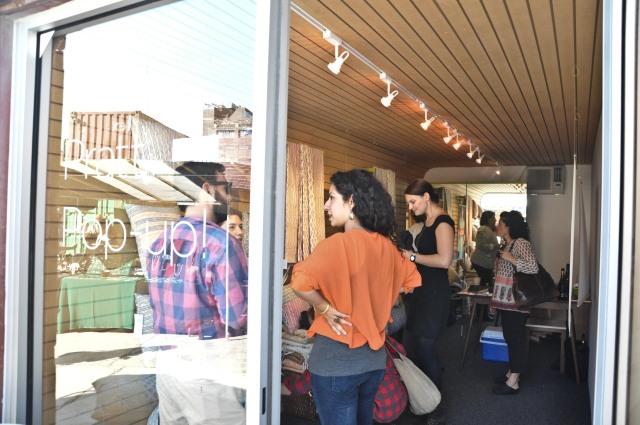
Handloom is coming to my old ‘hood, Fort Greene, Brooklyn! I'm so pleased to see that the handloom organization Tilonia, run by my friend Ellen Fish, will be displaying their wares in lovely Fort Greene through the Pratt Pop-Up! store at Dekalb Market until October 16. I lived in Fort Greene for eight joyful years and started my business in my apartment there, so that area definitely holds a special place in my heart.

Tilonia is a non-profit organization that employs a variety of artisans through the Barefoot College, an NGO that works to improve the lives of the rural poor by addressing basic needs for water, electricity, housing, health, education, and income. Through its production of home goods and accessories, Tilonia creates an income stream for artisans in the Indian state of Rajasthan.

Here’s what I love about the Barefoot College: its work is based upon the belief that though the poor may be uneducated, they still have the fierce desire to provide for themselves and their families. This organization, at work for over thirty-five years, is known especially for their solar energy program, which trains rural women to install solar electricity in their rural, remote, and often non-electrified villages.

The Barefoot College also does important work in many other areas, including health care, environmental causes, and women’s entrepreneurship and empowerment. Because of their inspirational work to support and sustain village life, I’m proud to say that the Barefoot College will be one of the organizations supported by our commitment at smitapauldesign.com to donate 10% of sales to charitable organizations. My hope is to support women from the villages where I work to go through the solar energy program. Until our site launches (stay tuned!), please go out and support Tilonia at Dekalb Market! For pictures of the shop in action (such as the one above), see www.designhope.wordpress.com .

Hello again!

Hello again! I know…it’s been a long time since I’ve posted on this site.

You will just have to forgive me. The truth is, I’ve been busy.

My mission has always been to employ as many handloom weavers as possible and to raise awareness about the social and ecological benefits of handloom. Slowly but surely, it seems to be working.

In 2008, one the most respected clothing companies in the United States approached me to create a line of private label scarves for their label. This company is committed to human rights, supporting women’s empowerment, and clean, sustainable social practices, and handloom scarves seemed like the perfect fit for their label.

Thus, I had a decision to make: working for this label would mean the production of thousands of scarves, and therefore the employment of hundreds of workers…but it would also mean closing my shop in Brooklyn and taking a break from my clothing line. Thousands of units versus several dozen scarves a season? I couldn’t resist the opportunity to make a difference in so many people’s lives, and I closed up my shop.

What a wild ride it’s turned out to be! Since I last posted, I’ve been to India at least a twenty times, with the occasional stop in Hong Kong and Thailand. I’ve weathered typhoons, transit strikes, red tape spaghetti, and maneuvered my way past a few unscrupulous individuals…believe me, I’ve got enough stories for an entire book—and then some.

I’ve also learned many lessons (some of them tougher than others) about how business gets done in India—all these many months later, I now feel like a seasoned pro. I’m proud to say that I’ve overseen the production and shipment of more than 50,000 scarves in the past three years. Whew!

There have been a lot of personal changes during this time as well. In the summer of 2009, I fell in love…with a bright orange Vespa... In a weird way, the joy of riding my scooter helped me to fulfill a long-standing desire to move to California. Why? Well, in California, I can ride my fabulous scooter year ‘round! Now, I ride my Vespa to my office in a fun neighborhood called “Dogwatch,” and I’m slowly building a community here. I still travel to New York and India on a regular basis, so now it feels like I have three hometowns. Can you tell I feel lucky?

My wholesale fabric business is flourishing, as is the private label business that I began working with in 2008. And here’s an important bit of news: I’m launching my own line, Smita Paul Design! My new website, smitapauldesign.com, will go live in the next few weeks, so stay tuned to the blog for news and sneak peaks. I’ll be starting with scarves, but in March of 2012, women’s clothing will also become available. After three years of learning, I’m rediscovering my dream.

And as for this blog, I promise to be back more often with stories from my journey, interviews with other social entrepreneurs, and interesting bits of news from the handloom front. You might see a write up or two about other designers who are part of the “wear handloom” revolution as well.

Thanks to those of you who’ve stuck with me these many years, and thanks to any new readers just making their way to this blog. Feel free to comment away! Find me on Facebook (Smita Paul Design/Indigo Handloom) and on Twitter at @smitapaul.

Saturday, July 04, 2009

Village Inspiration

Dispatch: Inspiration

I went to the village and was renewed. I always feel so inspired by going to the people who make the goods: to see their life, their struggles and the art they so carefully produce. It really amazes me, even all these years later..so much effort, so much struggle!

I filmed this man making a jamdani sari and interviewed him afterwards. He was 33 and almost completely illiterate – he could only sign his own name. I’ve interviewed dozens of weavers over the years and most of them prefer to stay in their village – they only want more weaving work.

While the domestic market for saris is always there, handloom weavers get paid approximately 20% more pay to work on export quality goods. It feels good to know that by just one bulk scarf order, I can employee hundreds of people…most of whom have few choices.

If the handloom market dries up – what choice does a landless, uneducated man or woman really have in India? The city is already clogged with millions desperate for work because they can no longer make a living in the rural areas.


This 74-year old man has been weaving for more than 50 years. He said in an interview that this is the only skill he has to support himself. His specialty is weaving khadi - which is hand-twisted, handwoven fabrics - which I will discuss in a future blog post.

Handloom is India’s second largest rural industry – behind farming. And in areas were the handloom industry has collapsed, there is upwards of 70% unemployment.

And if you really want to talk environment…just go into the area where weaving is on the decline. The first thing people do when they are desperate is attack their environment.

I notice that in the five years I have been coming into the region, the amount of logging has multipled at least 5 to 6 times. Some of it is legal and some of it is not…but all of it is dangerous if you consider how vulnerable this area is to flooding.

When you go into the villages, everywhere you look you see people involved with weaving. Walking along, you hear the clicking sound of weavers working the looms. You will find them inside people's homes, on their front porch and in clusters around the village.


I always find it rather soothing and gratifying. I have so many struggles to deal with: juggling funds, customer demands, production problems and meeting deadlines. But when I come to the village, and walk along the alleyways listening to the sound of weaving continuing, I feel renewed.

Business Meetings: Indian style

Business Meetings: Indian style

Today I went to one of the oldest markets of Calcutta to buy some silicia gel packets.

One of my customers asked for some handloom silk scarf samples last season. We were in the midst of monsoon season - so we didn't have much time. Since they use the sun to dry out everything and there was a week of continuous rain, the scarves showed up on her desk in New York City a soggy mess. Later, they were shipped to my customers' office in Hong Kong. Soon after, I got a note that they were nervous because scarves were emitting a unpleasant smell.

So I told them what happened (monsoon, etc.) but they still want to take precautions. They asked me to put silicia gel packs into each scarf package to absorb moisture.

So I found a manufacturer in Calcutta. I called and even though I am speaking in English and he is responding in English – neither one of us seems to be able to understand one another.

Somehow the time and place are established via text message. Thank god for cell phones and text messaging! Half my work gets done because of it.

I show the taxi driver the text with the address and he drives to a street corner on a sidewalk that is overflowing with tiny sidewalk shops selling glass bangles, stainless steel pots and pans, rubber slippers…basically everything you can imagine.

The silica gel pack man comes to get me and takes me through this maze of a market to his office which is the size of a closet. It’s air-conditioned – so that is all that matters.

I am just there for silica gel pack – a $40 and 2-minute transaction in America – but I was there for at least two hours.

I always forget in my single-minded ambition to ‘get things done’ that business is done differently over here. It is all about the relationship – and quite frankly it is more interesting and pleasurably to know the people you deal with.

This is somewhat typical of an exchange I have every time I start a new business relationship with someone:

First he sent his assistant to fetch us coconut water and urged me to ‘be calm’….as sweat was pouring down my face.

Then the questions:

What country are you from?
“So you are an Indian – are you a Bengali?
Is your mother a Punjabi?
Is your father a Punjabi?
From where in Punjab are you from?

Then some somosas arrive.

But your name does not sound like a Punjabi name. Why?
There is a very famous actress of yesteryear named Smita Patil, do you know of her?
All your family is living abroad? Or do you have any relations in Punjab?
How many years there?
Which do you like better: India or abroad?
What is your sun sign?
Moon sign?
Your life partner?
Will you marry an Indian?

Tea arrives..

Do you live with your parents?
How far away do they live from you?
How many brother and sisters are there (in your family)?
Is your brother married?
Does he have children?
Do you know Bengali sweets? They are the specialization of this region.

A plate of sweets arrive…

What is your business?
Who do you work with?

THEN and only then, we talk silicia gel packs….

In the end, I bought my gel packs (turns out he had a much greener option made from clay) – and I had a new friend too. He even offered me a desk in the new office space he just purchased!

Visiting Kali

Dispatch – Kali Temple

I went to the Kali Temple tonight. The manager of the hotel warned against it – trying to steer me toward the more sane, more organized and basically more civil Birla Temple. I’ve been there before and it is very nice indeed – an all white-marble structure beautifully lit with modern concepts such as orderly passages, fans and an air-conditioned office for the management staff.

To learn more about Kali, click on this image.


But Kali temple was the heart of the oldest part of Calcutta and the region that grew up around it was how Calcutta or Kolkata got its name. Besides I have a growing interest in goddess worship and Kali is one of the most fascinating and most misunderstood - in my opinion.

Kali is 'the scary' one. You know, she's always there with her tongue sticking out, holding severed heads, weapons and wearing a corset of skulls...you'll know when you see her. She's been associated with motherhood, fierceness, and is often described as 'angry' female energy. Certainly she looks fierce but there is much more to the story.

So I jumped in a taxi and went. He dropped me outside this narrow alley way that lead to the temple. Along the way, there are hundreds of little stands and stores selling temple souvenirs, garlands and all manner of goods used in Kali worship.

This is the pathway on the way to the temple.

As soon as I got there, being so obviously from out-of-town, one of the guides spotted me and started giving me instructions on what to do.

After depositing my slippers, he lead me up into the temple. It was so unbelievably crowded – it is easy to see how people could get trampled.

He made like a little cage with his arms and chest around me so he could use his body to shove through the crowd. Everyone was complaining loudly to two large women who were inside the inner section and blocking the way. Finally after being harassed by the crowd the two women emerge and fought their way out.

I got shoved in by my guide and then another man grabbed me (he may have been a priest or helper) and made me bow two times in front of the idol. He asked my name and spoke it to Kali and then asked for 200 rupees. When I asked if it was for the temple, he said yes but slipped it into his pocket.


This woman is getting fierce about selling garlands outside the temple grounds!


Then my guide took me to a tree that was in the temple compound. It has all kinds of scarps of paper, beads and rocks tied with string around its’ limbs. He told me that people wrote their prayers and wishes and tied it to the tree since it was a direct link to Kali.

Supposedly the image of Kali is meant to teach man about all the cycles of life including pain, sorrow and destruction. There is no way to overcome or conquer pain and sorry - it is only to be experienced. Just as other traditions tell us, to truly live, one must consider or accept death. Kali's gift is to understand that there is freedom in living and reveling in the moment. To ignore death or to pretend your ego is at the center, is to provoke Kali to laugh at you.

I think it is so interesting that the origin of the name Kali is the feminine form of Kala, a Sunskrit word for time. Her three eyes are telling you that there is a past, present and future but she tells you the power lives in the present.

I have also read that she reminds you of the power of your thoughts (negative and positive) - and that no one can protect you - not even the gods and goddesses.

Before I had a chance to even consider a prayer to Kali, the man whipped out a little book with names of westerners with their country written next to their name. There was also a place someone had written how much they had ‘donated’ to the temple. There was a range of 2000 ($40) to 4500 rupees ($100).

I don’t know if they really donated that much or if it was all made up to influence other westerners into giving up that kind of money. But I wasn’t buying it. I told him there is no way I’m going to give him that much money – so forgetaboutit.

He gave me the speech that I’m sure he gave every western tourists…the money was going to help the poor people, the temple, more money = more blessings for my own family…etc. etc.

I gave him 200 rupees to thank him for the ‘tour’ and told him I didn't think Kali would be disappointed with me.

I find that in India – the more uncomfortable or seemingly dangerous a tourist attraction – the better return for all the scam-sters and petty thieves. India can be incredibly luxurious and incredibly uncomfortable…and both extremes will cost ya!

Friday, July 03, 2009

Dhaba Diving

June 8th – India

Dhaba Diving:

I’m on my way to the village to check on production and quite frankly, I’m starving…we left at the crack of dawn to avoid the heat and traffic from Calcutta.

I have to go check on a bunch of handloom scarves that an American corporate client of mine ordered. This is really Suchita’s job – and this is one of the reasons I had to fire her. But it’s okay – since I always like to set down some standards for the weavers on each large order…. and going through each piece myself is the only way to do it.

But back to my stomach:

On the highways of India, there is often very little to eat…just little roadside shacks selling tea and sometimes ancient looking biscuits.

So everyone relies on roadside eateries called ‘dhabas.’ I approach dhabas and driving in India the same way: it’s best not to look.

If I really look at how the food is made…and spend too much attention to all the things that might go wrong, I’ll never eat anything.


Here is a quick peak of my breakfast being made….you can't beat the atmosphere!

This guy actually made me the most delicious paratha stuff with spicy potatoes. I love that dhabas usually only have ONE thing on the menu - take it or leave it. Today it was aloo paratha with fresh yogurt...a typical Punjabi breakfast.

My first experience with dhaba was because of a young student I hired as a translator in Karnataka . After we finished our interviews she asked if I wanted to try some chicken kebabs. We drove right up to this darkened shack and waited on some broken down old benches.

I nervously watched as the cook waved away a mass of flies who were laying near the frying vat before he started our meal. My mind made a quick reference through all the diseases I might catch - but ultimately my stomach won.


This is a typical dhaba. Sometimes they have open air kitchens but this one is has a structure.


I ate everything. I didn’t die or feel bad in any way….and by now I’ve eaten hundreds of meals in dhabas…and I have yet to get sick!

It is actually kind of amazing - I've tried all kinds of tasty things while on the road. These delicious little stuffed peppers in Orissa and amazing mango lassis in M.P...and lots and lots of fried fish in West Bengal!

Energy vs. Organic

Energy vs. Organic

People ask me all the time whether my stuff is made with organic cotton or dyed with vegetable dyes. So let’s just get this out of the way: the answer is no.

The entire fashion world seems to focus on organic cotton in their attempt to be more ‘green.’ While I applaud their motivation and efforts, I don’t think using purely organic cotton is ever going to satisfy the world’s thirst for cotton.

Plus it is so unpredictable, it will always have to be mixed with regular cotton to give us what we have come to expect from garments: durability and predictable shrinkage. For this reason very few companies can actually produce 100% organic clothing.

Some cotton being made into 'khadi' yarns for some handloom cotton cloth.

I'm not knocking organic cotton - I'd just like to see the industry approach their energy footprint as a way to become 'green.'

By just shifting to handloom, they can offer garments with significantly less impact on the earth.


Veggie Dyes:

I have the same issue with vegetable dyes. I have attempted a few times to work with natural dyes and watched as all kinds of combinations of twigs, leaves and insects are cooked up to make a color.

Ultimately, I believe using vegetable dyes is more wasteful and potentially more harmful than using a non-toxic commercial dye. I have watched women in rural India scour the countryside looking for a certain leaf that creates a certain color. I can just imagine what would happen if vegetable dyes become popular.

In an effort to make ourselves greener, we will create more destruction on wild environments. I’d rather use the extremely efficient commercial dyes. They have to gather a ton of leaves to make enough of dye for just 10 meters of cloth and waste more energy heating up the water for what in the end is a washed out looking color.

This sari was made with all vegetable dyes. While it is beautiful, it also took about two years to make!

Nuapatna

Everyone Should Know About Nuapatna

I started this company in 2003 after more than a dozen years as a journalist. It was on a story that I discovered the immense richness of handmade cloth. My first encounter with ‘handloom was in Nuapatna, a tiny village near the eastern coast of India in the state of Orissa.

The villagers of Nuapatna have been weaving handloom cloth – mostly saris – continuously for generations. One family can count back six generations and more than 300 years of weaving. I was struck by the skill with which the cloth was made – the designs were dyed before weaving using a resist method called tie-and-dye in India, also known in the world as ‘ikat.’

The ability to dye the design properly was key and involved multiple skills: precision, mathetamatical calculations and artistry. Almost 80% of the population works on handloom – as a weaver, dyer, designer or spinner. Peek into any mud hut and a gleaming silk sari is usually on a loom.

The lady to the right is from the home of a master weaver where weaving has been done for at least the past 200 years. I took this picture of her while she was making the mid-day meal in an old cotton ikat sari.

I’ve always loved textiles and fashion. While I was a journalist, I did a number of stories in India and other parts of the subcontinent. After each story was filed, I would reward myself with a trip to the local textile shops. I researched textiles in every corner of the world my stories took me.

I had seen a lot, but Nuapatna blew me away. I was also struck by how the artisans, who made this amazing handloom cloth, lived in such poor conditions. The world knows and celebrates ikat from such diverse places: Thailand, Yemen and Peru. In fact, at one point in history the entire world wove ikat and lusted after the finest ikats from India.

But Nuaputna had fallen off the map. It is well know by textile historians and museum curators and the saris produced are sold in the local cities. Otherwise, is was not flourishing in that way it should considering the level of skill and artistry….mostly because the world did not know about it.

I recently took a trip back to Nuapatna. Even though it was 110 degrees when I took this video, it didn't stop these children from enjoying themselves.


So a few years later, I decided to take a hiatus from journalism and plunge into the world of textiles. I had no contacts and in the beginning, not even a clear idea of how I would do it, but I felt the world should know about Nuapatna and thousands of villages just like it.

Handloom is the Ultimate in Green Fashion

The Ultimate in Green Fashion:

I started Indigo Handloom as a social project: I thought I would put to use my own creative urges and recast the cloth into something more modern, sell it in North America and provide a living for myself as well as for the villagers.

Along the way, I discovered that handloom is extremely good for the environment. It has almost zero impact upon the earth. No energy is required except for the machinery that spins the yarn used. In addition, the way most handloom weavers live is approximately 1/3 the carbon impact of an average Indian and an average Indian uses approximately 1/16 of the world’s resources as an average North American.

There are no building or transportation costs because most looms are set up in the homes of the weavers or within the village and the looms themselves are anywhere from 20 – 100 years old. They even use bicycles to transport materials from village to village!

When you examine a garment by the energy used to produce it, approximately 29% of the energy is used in the weaving of the cloth, according to the environmental group EarthPledge . I think it is safe to assume that the reverse is also true – if you use handloom you can reduce the impact of your clothing by at least 29%.


This young woman is weaving on her front porch. Across India, both men and women weave in almost equal numbers. It is a great way for women to support themselves and their families.

Friday, June 19, 2009

Welcome to the Good Karma Party!

The Good Karma Party!

In this blog you will witness my adventures as I build my social entrepreneurial company "Indigo Handloom." I named it such because indigo was the first color and handloom, in effect, was the first art form. My mission is to create high quality textiles by using the ancient craft of handloom and to create new markets for handloom weavers....as well as make a living for myself.

I supply custom made fabrics and scarves to western companies. We work with silks, cottons, speciality yarns and wool. Everything is done without any electricity in villages. I work mostly in the western part of India at the moment.

In this blog, I will write about my many trips back and forth to India, the characters who both help and hamper me. I will also take you along to the villages to see the people who make the cloth - they always inspire me!

This blog will also be a place to see updates on the progress of Indigo Handloom and news about the handloom industry. I might even throw in a few interviews with other social entrepreneurs, textile collections, designers and whomever else I find interesting.

I call it the "Good Karma Party" because I love the energy of other social entrepreneurs and I like to imagine we are all at the same party....

This is me on the road in India hunting for textiles and sampling local coconuts.